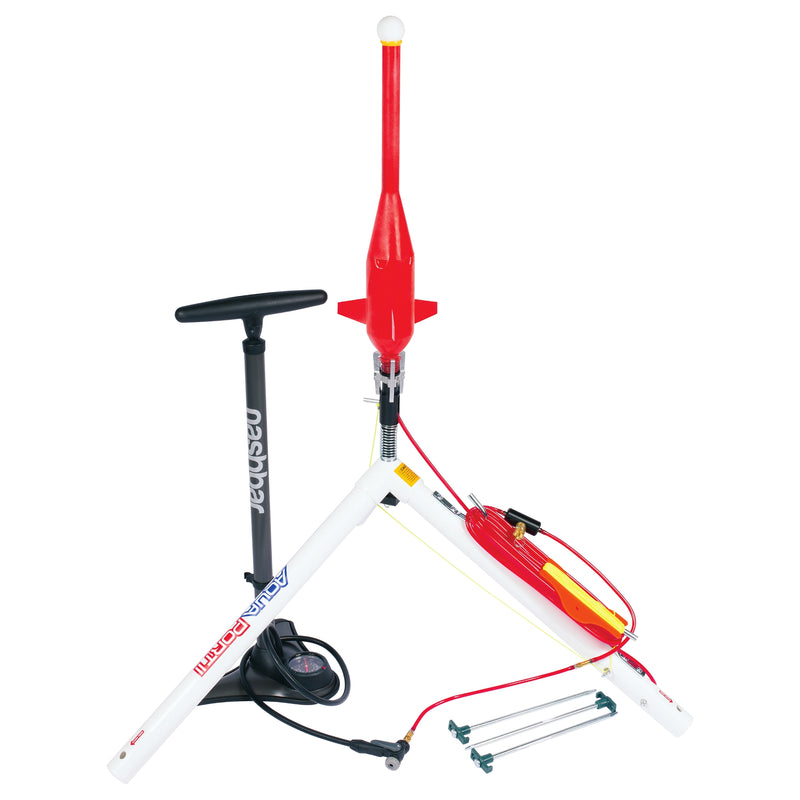

AquaPort II Water Rocket Launcher

From the manufacturer:

Water rocketry is one of the most fun and exciting hands-on science activities around. Converting empty plastic soda bottles into high-flying rockets provides a great opportunity for students to discover important scientific principles such as Newton’s laws, acceleration, thrust, and inertia.

A second-generation launcher, the AquaPort II was redesigned to be safer than ever and still offer consistent launching for water rockets of various sizes: 2 liter, 20 ounce, and some 1 liter.

The Basics

User Guide Pitsco AquaPort Rocket Launcher User Guide 
Teacher’s Guide Water Rockets Teacher's Guide Download (requires filling out info form) 
Assembly Tips AquaPort II Water Rocket Launcher – Assembly Tips 

Lesson Ideas

Engineering and Technology Water Bottle Rockets - Activity | TeachEngineering (Middle School)
Engineering and Technology Bottle Rockets | NASA (Grades 5–8)
Engineering and Technology Water Rocket Launch | Try Engineering (Grades 3–12)

Standards Connections

These resources can be used to support standards-based teaching and learning.  They are not intended to meet the full scope of any given standard.  Only some standards are highlighted; many more standards may be connected!  We encourage you to explore and to let us know if you have any questions!

3-PS2-1.  Plan and conduct an investigation to provide evidence of the effects of balanced and unbalanced forces on the motion of an object. 
3-5-ETS1-1. Define a simple design problem reflecting a need or a want that includes specified criteria for success and constraints on materials, time, or cost.   
3-5-ETS1-2. Generate and compare multiple possible solutions to a problem based on how well each is likely to meet the criteria and constraints of the problem.   
3-5-ETS1-3. Plan and carry out fair tests in which variables are controlled and failure points are considered to identify aspects of a model or prototype that can be improved.
MS-PS2-1.  Apply Newton’s Third Law to design a solution to a problem involving the motion of two colliding objects. 
MS-PS2-2.  Plan an investigation to provide evidence that the change in an object’s motion depends on the sum of the forces on the object and the mass of the object. 
MS-ETS1-1. Define the criteria and constraints of a design problem with sufficient precision to ensure a successful solution, taking into account relevant scientific principles and potential impacts on people and the natural environment that may limit possible solutions.  
MS-ETS1-2. Evaluate competing design solutions using a systematic process to determine how well they meet the criteria and constraints of the problem.   
MS-ETS1-3. Analyze data from tests to determine similarities and differences among several design solutions to identify the best characteristics of each that can be combined into a new solution to better meet the criteria for success. 
HS-PS2-1. Analyze data to support the claim that Newton’s second law of motion describes the mathematical relationship among the net force on a macroscopic object, its mass, and its acceleration.
HS-PS2-3. Apply scientific and engineering ideas to design, evaluate, and refine a device that minimizes the force on a macroscopic object during a collision.

Related SPA Tool/Kits

Straw Rocket Launcher 
Mini Straw Rocket Launcher 
  • AquaPort II with attached air valve, air hose, launch cord, and leg
  • 2 additional legs
  • 3 stakes
  • Super Lube
  • 1 bicycle pump