
The Basics
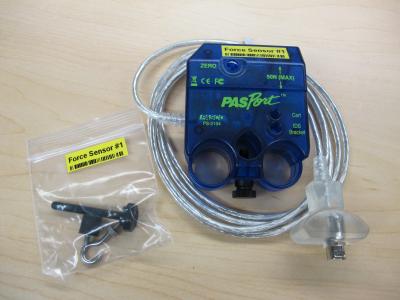
These resources may be for a newer model of the sensors we offer. The function should be the same if not similar to what we offer.
Lesson Ideas
| Physical Science | Work, Force and Motion | Big Sky Science Partnership (Grade 5) |
| Physical Science | Heavy and Heavier - Lab Experiments | PASCO (Elementary School) |
| Physical Science | Conservation of Matter - Lab Experiments | PASCO (Elementary School) |
| Physical Science | Introduction to Force - Lab Experiments | PASCO (High School) |
| Physical Science | Newton's Second Law - Lab Experiments | PASCO (High School) |
| Physical Science | Newton's Third Law - Lab Experiments | PASCO (High School) |
Standards Connections
These resources can be used to support standards-based teaching and learning. They are not intended to meet the full scope of any given standard. Only some standards are highlighted; many more standards may be connected! We encourage you to explore and to let us know if you have any questions!
| 4-PS3-1. Use evidence to construct an explanation relating the speed of an object to the energy of that object. |
| 4-PS3-3. Ask questions and predict outcomes about the changes in energy that occur when objects collide. |
| MS-PS2-1. Apply Newton’s Third Law to design a solution to a problem involving the motion of two colliding objects. |
| MS-PS2-2. Plan an investigation to provide evidence that the change in an object’s motion depends on the sum of the forces on the object and the mass of the object. |
| HS-PS2-1. Analyze data to support the claim that Newton’s second law of motion describes the mathematical relationship among the net force on a macroscopic object, its mass, and its acceleration. |
| HS-PS2-3. Apply science and engineering ideas to design, evaluate, and refine a device that minimizes the force on a macroscopic object during a collision. |
Related SPA Tool/Kits
| Coral Reef Wave Energy Activity Kit |
| Pasco Motion Sensor |
| Pasco Newton’s Laws Experiment |
| Pasco Goniometer Sensor |
| Eisco Force Table |