Horizontal Wind Turbine Kit
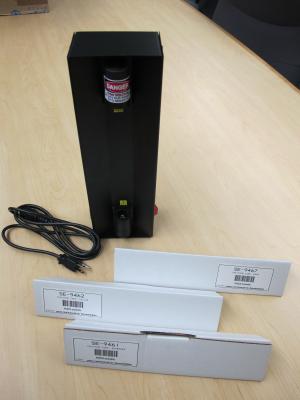
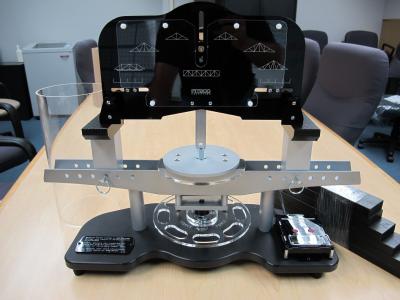
Are you looking for a hands-on EDP Challenge for your students? University of Hawai‘i engineering students adapted a wind turbine generator to help teachers learn and teach the Engineering Design Process (EDP). The horizontal wind turbine activity challenges students to design and manufacture blades to transform wind energy into electrical energy using electromagnetism concepts.
Teachers use this tool to cover EDP, electromagnetism, and circuits. The kit includes: Wind turbine test frame, industrial fan, multimeter, and test lamp. (This kit does not include consumable supplies to build the blade.)
HyperDuino – Basic Starter Kit
HyperDuino is an incredible concept that was created by Roger Wagner (writer of the original Apple II documentation!). HyperDuino kits allow users in any skill range to build physical, interactive projects in no time at all using an Arduino and the HyperDuino board. Beginners might make an interactive display that lights up when you press the right button. An intermediate user might add interactive video to the display. And the advanced user can take full advantage of the power of the arduino and create something truly amazing. It’s quite stunning how quickly and easily these projects can be created.
Here are some links to HyperDuino documentation provided by the designer:
HyperDuino – Mini-Makerspace Class Parts Set
The HyperDuino Mini-Makerspace Class Parts Set contains everything you need to bring the HyperDuino Basic Starter Kits to a whole classroom full of students.
Here are some links to HyperDuino documentation provided by the designer:
Inclined Plane
The Inclined Plane is a classic tool for exploring force, motion, and mechanical advantage in a controlled, hands-on way. Students use the adjustable-height ramp to investigate how the angle of an incline affects the effort needed to move an object. With built-in pulley support and a stable base, this kit is perfect for conducting experiments on friction, acceleration, potential and kinetic energy, and Newton’s Second Law.
Insta360 Camera
The Insta360 camera allows students to capture immersive 360-degree photos and videos, making it a powerful tool for documenting scientific investigations, field observations, and engineering projects. Unlike a traditional camera, this device records everything around it at once, allowing viewers to later explore the scene from any direction.
In STEM classrooms, the Insta360 can support authentic scientific practices by helping students collect visual evidence, document procedures, and analyze environments. Students might record a field study, capture multiple perspectives of a classroom experiment, or document the steps of an engineering design project. The resulting footage can be reviewed interactively, allowing students to examine details they may have missed during the original activity.
Kill-A-Watt Power Meter
The Kill-A-Watt power meter measures and records appliance power consumption and calculates power cost based on local power companies’ price per kilowatt. Students can investigate “standby power”, and explore the energy consumed by appliances even when they are turned off.
Kinesthetic Model of the Sun, the Moon, and the Earth
This hands-on kit helps students physically model the motions of the Earth and Moon to understand day and night, lunar phases, and the interactions between the Sun, Earth, and Moon. Using a bright lamp to represent the Sun and handheld “Moon” spheres, students move, rotate, and observe light and shadow directly—turning abstract astronomy concepts into a concrete, memorable experience.
In this activity, each student represents the Earth while holding a small “Moon” model at arm’s length. By rotating their bodies and moving the Moon around them, students can observe how sunlight reflects off the Moon and how different viewing angles create the phases we see from Earth. The model also demonstrates the cause of day and night as Earth rotates and highlights how the Moon orbits Earth over time.
The activity is designed as a teacher-guided, interactive investigation where students test ideas through movement and observation, compare explanations with classmates, and develop generalizations about how the positions and motions of celestial objects produce observable phenomena such as moon phases, eclipses, and tides.
This kit also includes Mahina Pahu Waiwai – Phases of the Moon.
Lego SPIKE Prime Set
The LEGO SPIKE Prime Kit is a hands-on robotics and coding platform that helps middle school students explore engineering, computer science, and physical science concepts through active problem-solving. Combining familiar LEGO building elements with motors, sensors, and block-based coding, the kit allows students to design, build, test, and improve interactive systems.
In the classroom, SPIKE is especially effective for engaging students in the engineering design process. Students define problems, build prototypes, write simple programs to control behavior, and iterate based on test results. Projects naturally integrate science concepts such as motion, forces, and energy with computational thinking skills like sequencing, loops, conditionals, and debugging.
littleBits STEAM Student Set
littleBits are just what they sound like! Little bits of technology that can be magnetically attached together to make just about any electronics-based maker project. The STEAM Student Set includes all the bits to occupy 3 students, or 6+ if grouped. The set contains 19 Bits and 45 Accessories, 8 Challenges, 6 Step-by-Step Resources, and an Invention Guide Book. Even better, a wealth of community-created content and tips are just a Google search away!
Magnet Lab Kit
From the manufacturer:
This Classroom Attractions Magnet Lab providess educators with the tools they need to implement a comprehensive magnet study program. With the easy to use educational guide, teachers will have all the tools necessary to present an effective and creative magnetism unit. Each set contains materials for work groups of five to ten students and is packaged in a convenient storage box. The Level 2 Classroom Attractions is recommended for ages 6 to 9 and grades 1st to 3rd.
- Classroom kit provides all the magnets and accessories to complement a curriculum-based science program
- Builds foundational physical and earth science knowledge for students ages 6 to 9
- Included teacher’s guide helps create an effective study program that aligns with the Next Generation Science Standards
Magnetism Discovery Kit
This hands-on Magnetism Discovery Kit gives students the tools to investigate magnetic forces, fields, and interactions through direct experimentation. The kit includes a wide variety of magnets and magnetic materials—bar magnets, ring magnets, horseshoe magnets, magnetic chips, compasses, and magnet blocks—along with four Eisco Magnetic Field Demonstrators that allow students to visualize otherwise invisible magnetic field patterns.
Students can explore how magnets attract and repel, identify magnetic poles, and investigate how magnetic forces act at a distance. Using the magnetic field demonstrator, learners can observe how iron filings or magnetic indicators align to reveal the shape and direction of magnetic fields. These experiences help students connect observations to scientific models and develop an understanding of magnetic interactions.
Mahina Pahu Waiwai – Phases of the Moon
From the publisher:
Learn the phases of the moon by shape and name with the Mahina Pahu Waiwai!
This kit is a great introduction to observation of the moon, keiki and makua work together to identify each phase and journal their findings.
Each mahina (month) consists of 30 moon phases. These phases are grouped into three periods called anahulu: Ho‘onui, Poepoe, and Hō‘emi. There are 10 moon phases in every anahulu.
Hoʻonui: The moon is growing larger.
Poepoe: The moon is round.
Hōʻemi: The moon is getting smaller.
Our kūpuna developed a close pilina (relationship) with the natural world through generations of kilo (observation). With this ‘ike, they would conduct their lives based on what they observed. Planting, harvesting, fishing, and family planning were determined by the moon phases.
With this kit, we hope to strengthen your pilina with the moon and incorporate it into your daily life.
This pahu waiwai (resource box) includes materials curated by the kumu (teacher) of Kūlaniākea to perpetuate ʻike kūpuna (ancestral knowledge) starting with our kūpuna (ancestor) in training, our keiki (child, offspring, descendent).
MakerBot in the Classroom
From the publisher:
Empower your students to design, collaborate, and create amazing things you never thought possible with MakerBot in the Classroom: An Introduction to 3D Printing and Design. Packed with resources, MakerBot in the Classroom gives you the basics of 3D printing and design as well as ideas, projects, and activities for integrating 3D printers in your curriculum.
Compiled by MakerBot Education
MakerBot Sketch 3D Printer
The MakerBot SKETCH is a classroom-friendly 3D printer designed to bring ideas to life through hands-on modeling, engineering, and iteration. With an intuitive interface, enclosed print chamber, and compatibility with cloud-based software (MakerBot CloudPrint), SKETCH allows students to design and fabricate real prototypes safely and reliably. Its manageable size and quiet operation make it ideal for classroom use, from daily STEM activities to long-term engineering projects.
MakeyMakey Designer Kit
MakeyMakey is a small circuit board that is connected to a computer via USB cable. The computer thinks that the circuit board is the actual keyboard! With alligator clips, students can attach various conductive objects to the circuit boards to design their own keyboards!
Normally, computer games and musical instruments are played using the standard keyboard. But with their very own MakeyMakey keyboards, just imagine the possibilities for students to design computer game controllers or musical instruments! MakeyMakeys have long been a student favorite for experiencing the engineering design process, learning about conductive and insulating materials, and as an introduction to circuitry.